
If your water heater is getting older, you have probably wondered whether it is time to switch to tankless. The answer depends on your household, your home and your budget. Neither type wins in every case.
Here is a plain comparison so you can decide what fits.
The short answer
- Choose a traditional tank if you want the lower up-front cost and a simple, familiar system that is easy to service.
- Choose tankless if you want hot water on demand, a smaller footprint and a longer-lasting unit, and you are comfortable with a higher up-front cost.
The two types are built for different priorities.
How a tank water heater works
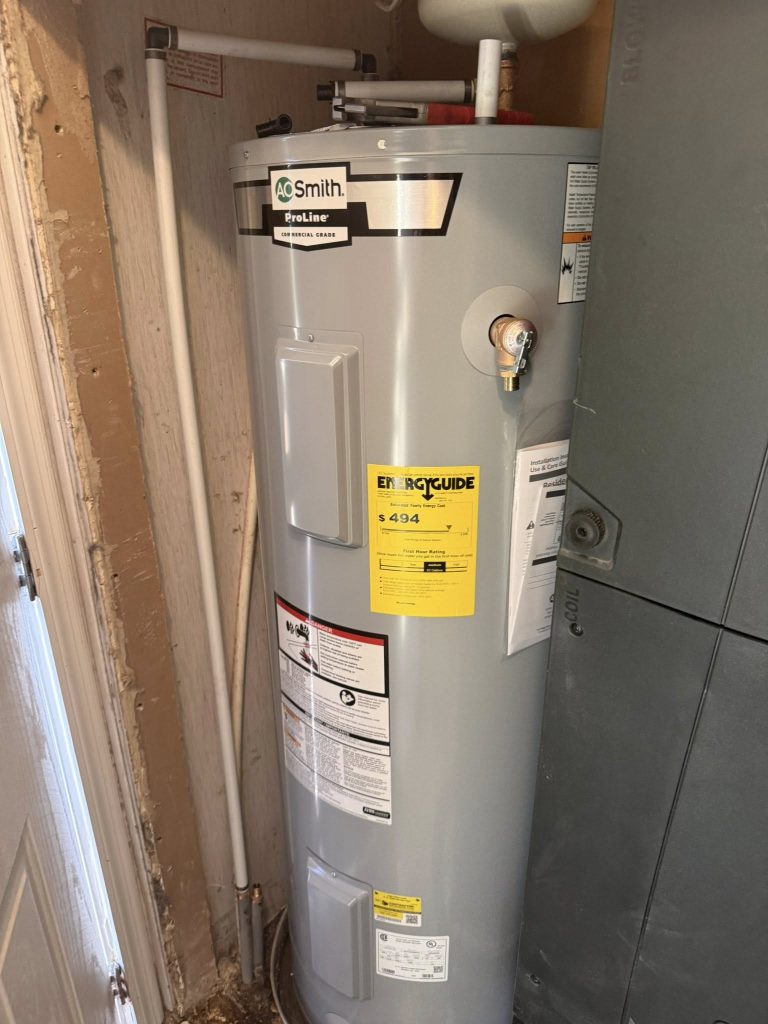
A traditional tank water heater stores and keeps heating a large volume of water, typically 40 to 80 gallons, so it is ready the moment you open a tap. When the tank runs low, you wait while it heats a new batch.
What homeowners like about tanks
- Lower up-front cost, and the most common option.
- Simple design that is straightforward to service.
- Often a direct swap for the unit you already have, if the fuel and venting stay the same.
What to keep in mind
- A tank typically lasts about 10 years.
- It keeps water hot around the clock, whether you are using it or not.
- It takes up floor space, and a big household can run out of hot water during back-to-back showers.
How a tankless water heater works
A tankless (on-demand) water heater heats water only when you turn on a tap. There is no storage tank and no standby heating.
What homeowners like about tankless
- Hot water that does not run out the way a tank can, as long as the unit is sized for your household’s busiest hour.
- Greater energy efficiency, because you are not heating a full tank 24 hours a day.
- Space savings, since the unit mounts on the wall.
- A longer lifespan. Tankless units commonly last close to 20 years, roughly double a tank.
What to keep in mind
- Higher up-front cost, especially for a first-time conversion.
- The unit has to be sized properly for your home, and a correct installation matters.
Tankless units can cost less to run, but whether that makes up the higher up-front cost depends on how much hot water you use, your fuel and what the installation involves.
Side by side
| Traditional tank | Tankless | |
|---|---|---|
| Typical lifespan | About 10 years | Close to 20 years |
| Hot water supply | Stored; can run out | On demand |
| Up-front cost | Lower | Higher |
| Space | Needs floor space | Wall-mounted |
| Energy use | Keeps water hot all day | Heats only when needed |
What a tankless installation can involve
A tankless installation is not always a simple swap. Depending on your home, it can involve upgrading gas lines, electrical service or venting so the unit can heat water on demand. It is worth having a plumber check the gas lines, electrical service and venting before you buy.
Permits are part of the picture too. In New Hanover County, the county’s permit chart lists a water heater replacement as needing no permit when a licensed contractor installs it, and as needing electrical/gas and plumbing permits when a homeowner does it (DIY). The chart covers replacements. A first-time tankless conversion that changes the gas line, electrical service or venting may need permits, so ask us how your job is handled.
East Atlantic Plumbing installs both gas and electric tankless water heaters across Wilmington and the surrounding area. We size the unit to your home and install it to code. We also handle tankless descaling and maintenance to keep it working well. See our water heater installation page for more on how we approach the job.
A note on Wilmington water
Water hardness is worth asking about for either type, because scale can build up when hard water is heated. The USGS says that scale can shorten the life of equipment such as water heaters. In the CFPUA 2025 Drinking Water Quality Report, the CFPUA-Wilmington system averages 50 mg/L (range 39 to 62), which the USGS scale calls soft. The Wrightsville Beach system averages 78 mg/L, which is moderately hard, with readings from 23 to 330 mg/L. These are system-wide figures for CFPUA customers, so the water at your own tap can differ, and homes on other water systems have their own numbers.
How to decide
Ask yourself a few plain questions:
- How many people use hot water at the same time? A larger household may benefit from on-demand hot water.
- How long do you plan to stay in the home? A longer stay lets you get more of a tankless unit’s longer lifespan.
- How much space do you have? If the closet, attic or crawlspace is tight, a wall-mounted unit saves floor space.
- What is your budget today? If up-front cost is the priority, a tank is the easier path.
- What do you have now? Gas and electric setups, and the venting you already have, shape what the installation will take.
If you are not sure, we can help. We look at your home, your hot water habits and your budget, and give you an honest recommendation.
To see how the installation visit works, read what to expect from a water heater installation in Wilmington. If you are still deciding whether to replace at all, our guide to water heater lifespan and warning signs covers what to watch for.
Frequently asked questions
Is tankless better than a tank water heater?
Tankless is the better fit for some homes and a tank for others. Tankless gives you continuous hot water when it is sized right, plus better efficiency, space savings and a longer lifespan. A tank costs less up front and is simple to service. The right choice depends on your household and budget.
How long does each type last?
A traditional tank typically lasts about 10 years. Tankless units commonly last close to 20.
Does tankless cost more to install?
Yes, tankless units cost more up front, especially for a first-time conversion that needs gas, electrical or venting upgrades.
Do you install tankless water heaters in Wilmington?
Yes. We install and service both gas and electric tankless water heaters throughout Wilmington and the surrounding towns.
Can I switch from a tank to tankless?
Often, yes, but it can require changes to gas lines, electrical or venting. We assess your home first and tell you what the conversion would involve.
Not sure which one fits?
Call East Atlantic Plumbing at (910) 616-3238 and we will talk through your options. You can also contact us online to schedule an assessment.